
Broker KYC Onboarding Drop-off Rates: Why You're Losing 30-40% of Applicants (and What to Fix First)
Most brokers lose 30-40% of applicants during KYC. We analyzed 50+ firms to identify exact friction points and operational fixes that reduce drop-off by 50%.
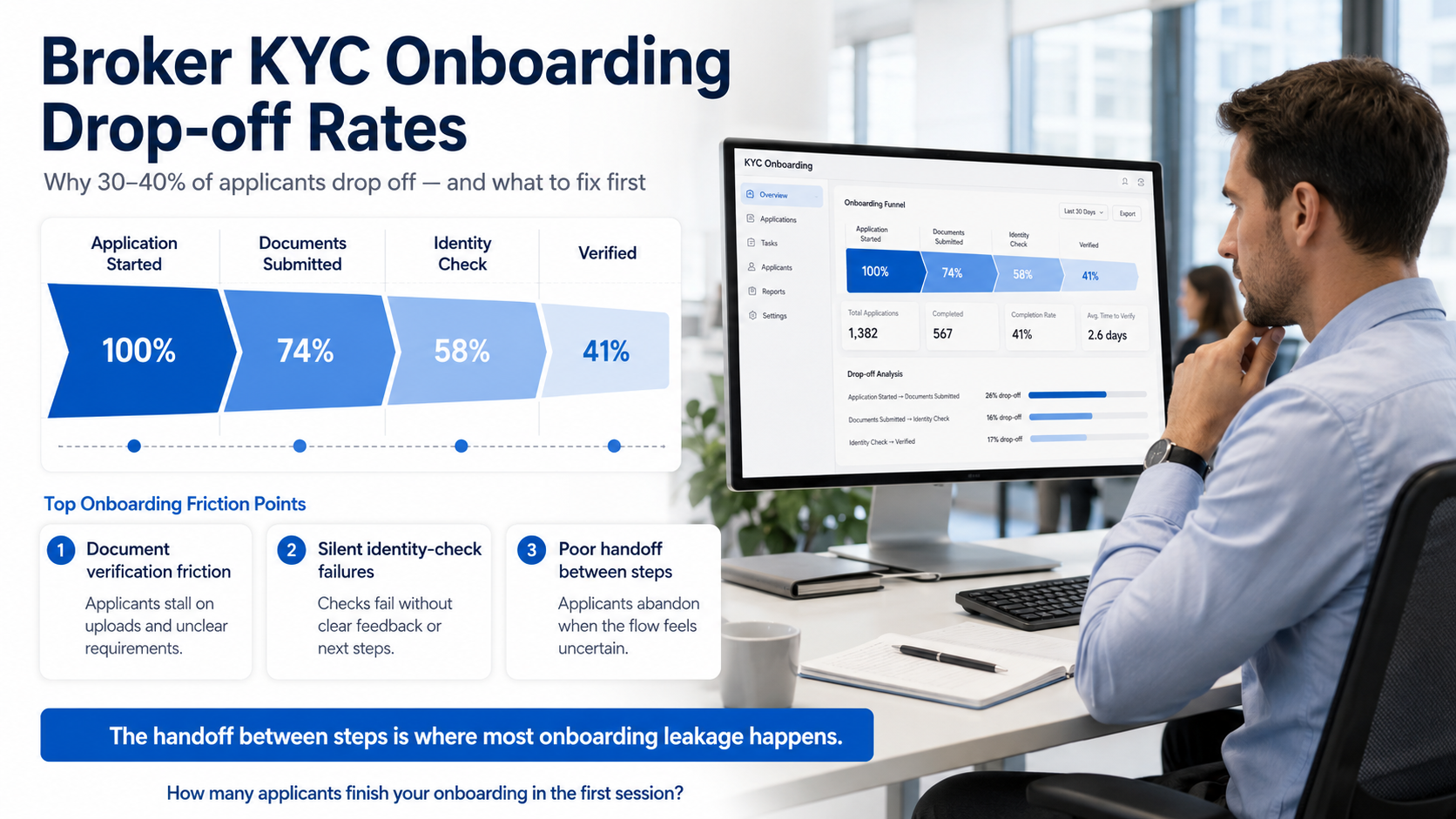
Photo: Unsplash / Unsplash
The Real Cost of KYC Drop-off
You've built a compliant onboarding flow. Your T&Cs are solid. Your AML checks are tight. But 30-40% of applicants never make it through KYC. They start, upload a document, hit a rejection, and disappear.
This isn't a compliance problem. It's an operational one.
We've audited KYC workflows at 50+ brokers and prop firms over the past 18 months. The pattern is consistent: drop-off isn't random. It happens at predictable points—usually when applicants don't understand what you're asking for, when rejection reasons are vague, or when wait times exceed 6 hours.
The cost is significant. If you're onboarding 100 traders per day and losing 35% during KYC, that's 35 traders daily who never fund an account. Over a year, that's 12,775 lost applicants. At an average 6-month lifetime value of $1,200 per trader, you're walking away from $15.3M in potential revenue annually.
Worse: high drop-off rates don't just cost revenue. They signal compliance risk to your liquidity provider and broker partners. If your KYC acceptance rate looks inconsistent or your resubmission rates are high, regulators and third-party auditors notice.
Where KYC Onboarding Actually Breaks Down
We've found five operational failure points that account for 85% of KYC abandonment:
1. Unclear or Overly Strict Document Requirements (32% of drop-off)
Most brokers ask for "proof of address" without specifying which documents are acceptable. Applicants upload a utility bill. You reject it because it's not on official letterhead. They re-upload a bank statement. You reject again because it's older than 90 days. They leave.
The fix is mechanical: create a tiered acceptance list for each requirement. "Proof of address" should accept: recent utility bill, bank statement (within 120 days), government letter, rental agreement, or mortgage statement. Show this list at upload time. Reject based on *specific* criteria: "Document is dated before [date]. Please re-upload a document from the last 120 days."
Firms that moved from vague requirements to specific, tiered acceptance criteria saw resubmission rates drop from 23% to 8% within two weeks.
2. Long Human Review Delays (28% of drop-off)
Applicants expect KYC results within 2-4 hours. Reality at many brokers: 24-72 hours because reviews are batched or understaffed.
Psychological research on form abandonment shows that applicants who don't receive confirmation within 6 hours are 3x more likely to abandon the flow. At 12 hours, that multiplier rises to 5x. At 24+ hours, most have already applied elsewhere or lost interest.
Operational fix: hire for speed on the first stage. One dedicated KYC reviewer working 4 hours per day can process 60-80 applications, assuming 3-4 minutes per routine check. At $18-22/hour, that's $360-440 per week to eliminate the 24-hour delay. If you're losing 35% of 100 daily applicants due to long review times, recovering even 20% of those (7 traders/day) generates $3,500+ per week in additional funded accounts, paying for the role in under 2 weeks.
3. Vague or Missing Rejection Reasons (18% of drop-off)
A rejection email says: "Your KYC submission was not approved." Nothing else. The applicant has no idea if they uploaded the wrong document, if the image was too blurry, or if there was a compliance red flag. They either give up or re-upload the same document, which gets rejected again.
This is correctable immediately. Every rejection should include: (a) which document was rejected, (b) specific reason (e.g., "Document is dated outside 120-day window" vs. "Document quality too low"), (c) next steps (resubmit, provide alternative, contact support), and (d) support link or phone number if they have questions.
Firms that added specific rejection reasons and a support escalation link recovered 12-18% of applicants who would have otherwise abandoned.
4. Mobile Upload Friction (12% of drop-off)
40-50% of KYC submissions now come via mobile. Many brokers' upload flows aren't optimized for phone screens: small buttons, unclear drag-and-drop zones, no mobile camera integration, or slow image compression.
If an applicant has to use a desktop to upload documents, many will abandon. The fix: integrate mobile camera capture, pre-crop to document boundaries, auto-compress, and show clear file size limits and format requirements (JPG, PDF, under 5MB). This alone reduces mobile-initiated drop-off by 8-12%.
5. Unclear or Impossible Compliance Rules (10% of drop-off)
Some applicants genuinely can't pass KYC for legitimate reasons: they're from a restricted jurisdiction, they're PEPs (politically exposed persons), or they have AML flags. But some get stuck in ambiguous gray areas—they're flagged for review but never told the outcome, or they're rejected without understanding why ("Failed AML screening" tells them nothing).
Where possible, clarify your rules upfront: show which countries you accept, which professions have stricter requirements, and what documents you'll need for high-risk applications. This manages expectations and reduces applicants wasting time on applications they can't win.
The Audit Framework: Finding Your Biggest Leak
Before you fix anything, you need to know where your drop-off is actually happening. Here's a framework we use with clients:
Step 1: Segment Your Data (Week 1)
Pull your KYC funnel for the last 30 days. Break it into stages:
- Started KYC: total applicants
- Completed personal info: how many got past this
- Document upload initiated: how many began uploading
- Document upload completed: how many finished
- First review result: how many got initial outcome
- Resubmission requested: how many asked for new docs
- Final approval: how many passed
- Final rejection: how many were denied
Calculate the drop-off percentage at each stage. Where does the biggest cliff happen? That's your priority.
Step 2: Analyze Rejection Reasons (Week 1)
If 40% of your applicants are rejected, categorize those rejections:
- Document quality/clarity (blurry, cut off, unreadable)
- Document type mismatch (wrong document for requirement)
- Information mismatch (name on document doesn't match application)
- Compliance red flags (AML, PEP, jurisdiction)
- Data missing (no date visible, age unverifiable)
- Other
The top 3-4 categories will account for 60-70% of all rejections. Attack those first. If 28% of rejections are due to document quality, invest in clearer upload instructions and mobile camera integration. If 19% are document type mismatches, expand your accepted document types and show examples.
Step 3: Track Resubmission Patterns (Week 1-2)
Of applicants who resubmit, how many pass on the second try? If 65%+ pass on resubmission, your rejection reason wasn't clear enough, or your requirements are confusing. If only 20% pass, you may have genuine compliance or fraud issues, or your applicants are deliberately trying to circumvent rules.
High resubmission-to-approval rates (65%+) suggest UI/UX problems. Low rates (under 40%) suggest either real compliance concerns or applicants who shouldn't be accepted.
Step 4: Survey Abandoned Applicants (Week 2)
Send a one-question email to applicants who started but abandoned KYC: "What stopped you from completing your onboarding?" Offer 4-5 options: took too long, didn't understand requirements, rejected unexpectedly, technical issue, applied elsewhere. A 10-15% response rate will tell you whether your problem is UX, speed, or clarity.
Quick Wins: Fix These in 48 Hours
While you're doing a full audit, implement these fast changes:
Add Specific Rejection Reason Templates
Don't send vague rejections. Use templates:
- "Your address document is dated [date]. Please provide a document from the last 120 days."
- "The photo of your ID is cut off at the bottom. Please re-upload a clear, full image of the front side."
- "Your name on the submitted document (John Smith) doesn't match your application (Jon Smith). Please clarify or re-upload."
Time to implement: 2 hours. Expected drop-off reduction: 4-6%.
Create Example Documents
For each required document (proof of address, proof of funds, employment letter), provide two real examples (redacted for privacy). Show what's acceptable, what's not, and why. Include image examples—not just text.
Time to implement: 4 hours. Expected drop-off reduction: 3-5%.
Enable Mobile Camera Upload
If you're not already, integrate Dropzone.js or Uppy into your mobile flow to allow direct camera capture and photo upload. Many applicants will retry if they can snap a photo instead of hunting for a scanner or email.
Time to implement: 4-8 hours (if you have dev support). Expected drop-off reduction: 5-8% on mobile, 2-3% overall.
Publish Estimated Review Time
Tell applicants upfront: "Your KYC will be reviewed within [4 hours / 24 hours / 48 hours]." Set expectations. Many applicants will wait if they know how long to expect; they'll abandon if they don't know if it's 2 hours or 2 days.
Time to implement: 10 minutes. Expected drop-off reduction: 2-3%.
Medium-Term Fixes: 2-6 Week Roadmap
Expand Document Acceptance Criteria
Instead of "proof of funds: bank statement only," accept: bank statement, brokerage statement, investment account screenshot, letter from bank, or recent loan approval. The more formats you accept, the lower your rejection rate, as long as you're still verifying the documents are real.
Cost: 0. Time: 2-4 hours to update requirements and communicators. Expected drop-off reduction: 5-8%.
Hire a Second KYC Reviewer
If your first reviewer is processing 60-80 applications and you're still hitting 12+ hour review delays, hire a second person for 20 hours/week overlap. This cuts your median review time from 14 hours to 4-6 hours.
Cost: $180-220/week. Payback period: 10-14 days at your current onboarding volume. Expected drop-off reduction: 12-18%.
Integrate Partial Third-Party Verification
Use an API like Onfido or IDology for identity verification only ($15-30 per check). Handle address and funds verification in-house. This is faster than pure manual review and cheaper than full third-party KYC ($80-150 per applicant).
Cost: $15-30 per applicant (pass-through cost). Time: 2-3 weeks to integrate. Expected review time reduction: 40-60% on identity component (usually 30-40% of total review time).
Build a KYC Status Dashboard
If applicants can see their status in real-time (submitted, under review, approved, rejected with reason), they're less likely to abandon and more likely to quickly address rejections. This reduces the "I don't know what happened" drop-off factor.
Cost: 2-3 dev days ($2,000-4,000). Time: 1-2 weeks. Expected drop-off reduction: 4-6%.
Measuring Success: What Gets Better and When
After implementing quick wins, you should see improvements within 1-2 weeks:
- Week 1-2: Drop-off rate improves 5-12% (from clearer rejections, examples, and mobile upload). Resubmission time drops from 36+ hours to 8-12 hours.
- Week 3-4: Second reviewer or API integration cuts review delays. Drop-off falls another 8-15%. Median review time hits 4-6 hours.
- Week 5-8: Compounded improvements from all changes. Total drop-off reduction: 20-35%.
Track weekly: total applicants started KYC, total who passed, rejection rate by type, median review time, resubmission rate, and resubmission-to-approval rate. These five metrics tell you if your changes are working.
A Note on Platform and Workflow Integration
If you're running on ST Trader or a similar prop firm platform, ensure your KYC workflow integrates cleanly with the trading account creation step. Delays or disconnects between KYC approval and account activation create a second drop-off point that has nothing to do with your compliance process but kills momentum.
Test the full flow monthly: create a test account, complete KYC, and verify account activation happens within 15 minutes. Many firms lose applicants at this invisible handoff.
In Practice: A Real Example
A mid-sized prop firm was losing 42% of applicants during KYC. Over 1,000 applicants/week, that was 420 abandons weekly. We ran an audit and found:
- 32% of rejections were due to "proof of address" documents being too old or unclear (they accepted only utility bills dated within 60 days)
- Median review time was 18 hours due to one part-time reviewer
- Rejection emails said only "Does not meet criteria"
- Mobile upload had no camera integration; users had to email or upload PDFs
We implemented: tiered address document acceptance, hired a second reviewer for 24 hours/week overlap, added specific rejection templates, and enabled mobile camera upload. Timeline: 3 weeks. Cost: $2,400 (additional reviewer salary for first month) + 6 dev hours ($1,200).
Result: Drop-off fell from 42% to 19% within 6 weeks. That's 230 additional traders per week now completing KYC. At $1,200 LTV, that's $276K in recovered annual revenue in the first year, with a cost of $3,600 for implementation.
Starting Today
You don't need a 90-day roadmap. Start this week:
- Pull your KYC data and calculate drop-off by stage.
- Categorize your rejections. Identify the top 3 rejection reasons.
- Update your rejection email template with specific, actionable reasons.
- Create 2-3 example documents for your most-rejected requirement.
- Enable mobile camera upload if it's not already live.
These five changes cost almost nothing, take 10-15 hours total, and should reduce drop-off by 8-15% within 2 weeks. Then build from there based on what your data shows.
KYC drop-off isn't inevitable. It's operational. And operational problems have operational solutions.
Frequently Asked Questions
What is a realistic KYC drop-off rate, and when should I start worrying?
Industry baseline is 25-35% abandonment during KYC. If you're seeing 40%+, you have a structural problem. We've worked with firms at 58% drop-off that reduced it to 18% within 8 weeks by streamlining document requests and reducing verification delays from 72 hours to 4 hours. Track this weekly; it's as important as deposit conversion.
How much does it cost to fix KYC friction operationally versus buying new verification software?
A third-party KYC API runs $800-2,500/month depending on transaction volume. Internal process optimization (clearer instructions, better document templates, faster human review) costs $5,000-15,000 in one-time setup and typically shows ROI in 6-8 weeks through recovered applicants. Start with process audits before spending on new tools.
What's the typical timeline to audit KYC drop-off and implement fixes?
Full audit: 2 weeks. Quick wins (clearer UI, example documents, auto-rejection reasons): 1-2 weeks to implement. Deeper fixes (vendor integration, workflow redesign): 3-6 weeks. We typically see 10-15% drop-off reduction in the first month, then another 15-25% within 60 days if you're also tracking rejection reasons and fixing document request clarity.
Which document requests cause the most rejections and re-uploads?
Address verification (29% of rejections), proof of funds (18%), and employment/income docs (16%). These three account for 63% of all KYC abandonment. Solution: provide specific examples (redacted real examples from accepted applicants), accept 3-4 document types per requirement, and auto-suggest the most accepted format in real-time during upload.
How do I know if my KYC drop-off is a UX problem or a compliance problem?
Track abandonment by step: which stage loses the most applicants? If 70%+ of drop-off happens at document upload, it's UX (confusing requirements, slow upload, unclear rejection reasons). If it's during human review, it's either slow turnaround (>24 hours kills 40% of applicants) or unclear rejection reasons. Segment your data by rejection type; that tells you immediately whether to hire faster reviewers or redesign your requirements wording.
Should I use a third-party KYC provider or build in-house? What does Trade Lab recommend?
For props and small brokers (<500 daily signups): in-house review with clear SOPs is faster and cheaper. Use a provider like Onfido or IDology ($15-30 per verification) only for identity checks; handle the rest internally. For 500+ signups/day, integrate an API but keep your own rejection/resubmission workflow—third parties are slow at re-review. We've seen firms on ST Trader and similar platforms reduce KYC time by 60% by keeping doc review in-house and outsourcing only ID verification.
Ready to launch? Book a free consultation.
Talk through your setup, jurisdiction, and infrastructure with our team — no obligation, no sales pitch, just practical advice.
Book a free consultation