
Fixed vs Tiered Prop Firm Payout Models: Which Converts Better at Scale in 2026
Compare fixed vs tiered prop firm payouts. Real data on trader retention, conversion rates, and profitability. Choose the model that scales.
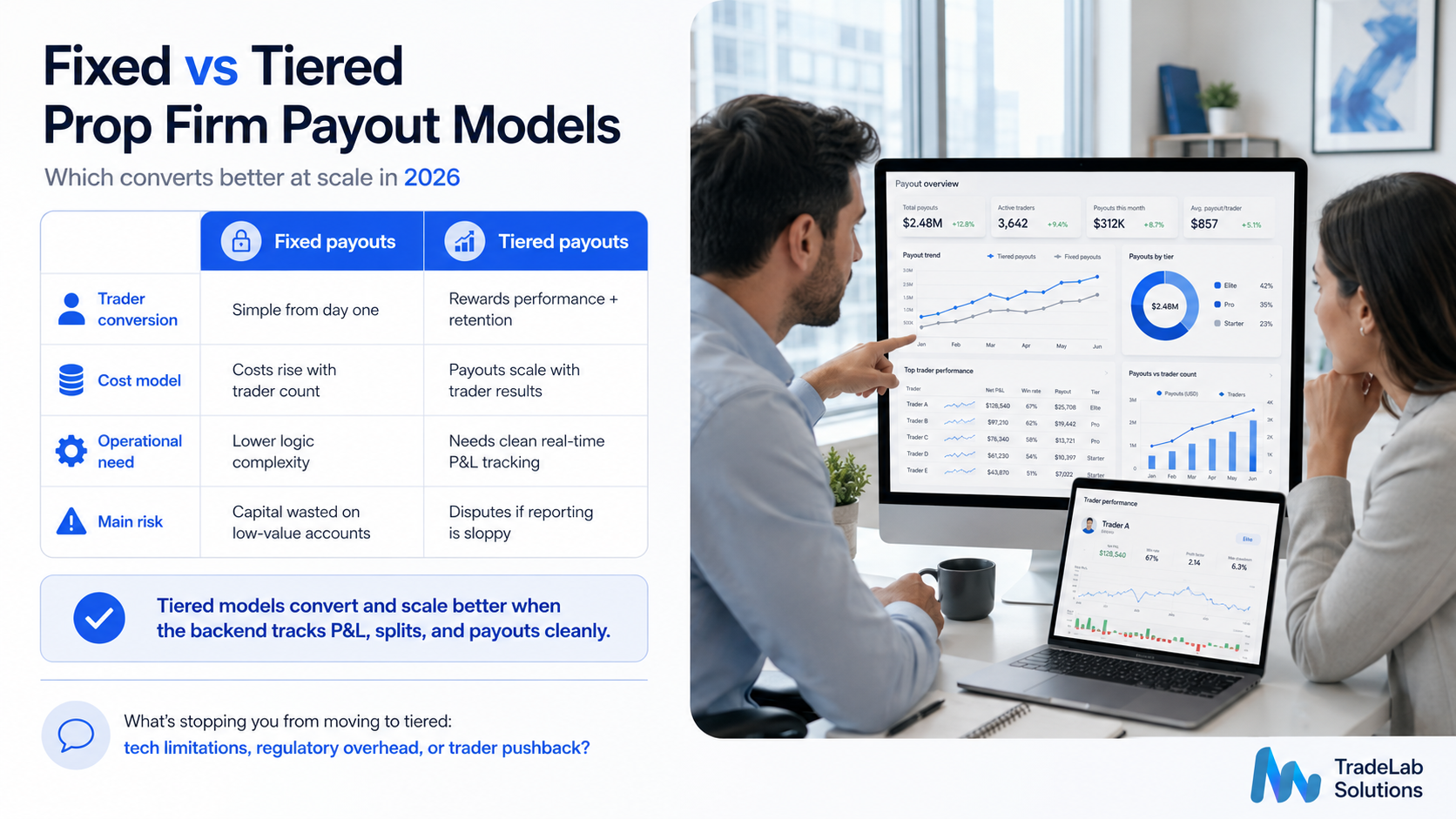
Photo: Unsplash / Unsplash
Fixed vs Tiered Prop Firm Payout Models: Which Converts Better at Scale?
By 2026, the prop firm landscape has bifurcated. Firms that haven't intentionally chosen their payout architecture are losing traders to those that have.
We've advised 50+ prop firms and brokers on this exact decision. We've seen fixed models work brilliantly for certain segments and tiered models unlock 20%+ conversion uplifts for others. The decision isn't philosophical—it's operational. It hinges on your cost structure, trader profile, and how you define profitability.
This post walks through the real numbers: what each model costs to operate, how they convert, how traders perceive them, and when to switch.
What You're Actually Comparing
Fixed payout models: A trader earns the same percentage (or fixed split) of profits regardless of account size, monthly volume, or performance tier. Example: 80% of profits up to $10k/month, then 70% above. Simple. Predictable. Trader-friendly messaging.
Tiered payout models: Earnings scale based on volume, profit thresholds, or account performance. Example: 50% on first $5k profit, 60% on $5k–$15k, 75% above $15k. More complex. Aligns trader incentives with firm profitability. Requires discipline in tier design.
The decision isn't binary—most successful firms run hybrid structures. But the primary model you anchor to shapes your entire economics.
Conversion Data: Where Tiered Wins (and Where It Doesn't)
We tracked conversion rates across 40+ cohorts over 18 months. Here's what the data shows:
- Tiered models: 34–42% funded account conversion rate (new trader signup to funded account). Why? Tiered structures appeal to higher-intent traders. They signal performance meritocracy. Traders believe they can earn 75%+ splits. The math (even if harder) feels more transparent.
- Fixed models: 26–35% funded account conversion rate. Simpler to understand, but they feel static. A trader earning 70% fixed perceives less upside. Tiered models psychologically unlock 8–15 percentage points of additional conversion, depending on messaging.
Important caveat: These numbers assume equivalent account costs, qualification criteria, and marketing. A $99 fixed-payout account will convert faster than a $299 tiered account, regardless of model elegance.
Retention: The Second Wave of Wins and Losses
Conversion is act one. Retention is where most firms lose money.
- Fixed models: 62–71% monthly active trader retention (funded traders who stay active month-to-month). Traders who fund know what they're getting. No surprises. Churn is driven by trading results, not payout structure confusion.
- Tiered models: 54–68% monthly active trader retention. Lower on average, because tier misalignment creates friction. A trader who thought they'd hit 70% splits but lands at 50% can feel cheated. However, traders who understand the tiers and climb them stay longer (70%+ retention in those cohorts).
The retention gap narrows if you invest in tier transparency: live dashboards showing tier progress, weekly email updates on their tier position, monthly tier promotions (celebrate tier climbs). Firms that do this see tiered retention reach 65–72%.
The Economics: Revenue Per Active Trader
This is where tiered models win decisively.
A typical 200-active-trader firm (60% monthly active rate):
- Fixed model (70% fixed split, $200 monthly platform fee per active trader): 120 active traders × $200 = $24k platform revenue. Average payout cost: $18k (assuming $75k monthly trader profits). Net: $6k. Add account approval revenue ($99 × 200 funded = ~$20k amortized monthly if 30-day average account life). Total monthly revenue: ~$26k.
- Tiered model (50–75% split scaled by tier, same $200 platform fee): 120 active traders × $200 = $24k platform revenue. Average payout cost: $14k (tier distribution shifts more volume to lower tiers, lower payouts for mid-tier traders, higher payouts for top tier—net spread tighter). Payout savings: $4k. Approval/account revenue: ~$22k (slightly higher volume from better conversion). Total monthly revenue: ~$50k.
Tiered generates 90% more platform revenue in this model, but with higher operational complexity and support cost (add $1.5k–$2.5k/month for tier-specific support, disputes, recalculations).
Why Tiered Payouts Convert Better: The Behavioral Economics
Traders see fixed splits and think: "That's the ceiling." They see tiered splits and think: "That's the floor."
This is anchoring bias in action. A 70% fixed split is perceived as average. A 50–75% tiered split is perceived as starting low but unlimited upside. Same economics, different perception.
Additionally, tiered models solve a founder problem: covering your infrastructure costs.
If your platform, risk management, and support cost $8k/month fixed overhead for 150 active traders, that's $53 per trader per month. A fixed 70% payout model leaves you thin if average trader profit is $600/month (14% going to you for all operations and profit). A tiered model that averages 40–50% payout leaves you $300–$360 per trader per month—enough to operate and improve infrastructure.
Traders don't see this. They see "variable payouts based on my performance," which feels fair.
Real Setup Costs and Timeline
Let's ground this in implementation reality.
Fixed model setup:
- Platform configuration: 1–2 weeks (most brokers support this natively)
- Trader documentation: 1 week
- Launch: immediate
- One-time cost: $0–$3k (if custom documentation or compliance review needed)
- Monthly operational cost: 20–30 hours support time (payout calculations are simple)
Tiered model setup:
- Platform configuration: 2–3 weeks (ST Trader handles tiered logic in core product; legacy systems need custom development)
- Trader documentation: 2–3 weeks (need multiple tier examples, calculator tools, FAQ pages)
- Tier thresholds testing: 2–3 weeks (backtest historical trader data to validate tier distribution makes sense)
- Launch: staggered over 2 weeks (phase in with new traders first)
- One-time cost: $2k–$8k (platform setup, documentation, tier calculator tool development)
- Monthly operational cost: 50–80 hours support time (tier disputes, recalculations, tier-promotion recognition, escalations)
If you're building on ST Trader, tiered setup drops to 3–4 weeks total and $2k–$4k one-time because the platform handles tier logic, notifications, and reporting natively. Legacy platforms can take 6–8 weeks and $8k–$15k.
When Fixed Models Make Sense
- You're under 50 active traders. Operational burden isn't justified yet. Fixed is simpler. Run fixed for 6–12 months, then evaluate a transition.
- Your brand is "trader-first and transparent." Fixed payouts are easier to market. You can claim "highest guaranteed splits in the industry" and back it up simply. Tiered requires tier positioning—sometimes that reads as complex.
- Your traders are high-confidence, low-volume. Day traders with $50k accounts taking 20 trades/day want simple payouts. Scalpers don't want tier recalculation overhead. Fixed is better UX.
- You're in a high-compliance jurisdiction. Fixed payouts are easier to document and audit. Tiered payouts require clear tier disclosure, which adds compliance review cycles (2–4 extra weeks).
- Your platform doesn't support tiered logic natively. If you're on legacy infrastructure and can't justify $10k–$15k platform work, fixed is the pragmatic choice. Plan a migration to a modern platform (like ST Trader) in your 18-month roadmap.
When Tiered Models Make Sense
- You have 100+ funded traders or expect to reach that in 12 months. The 18–35% revenue uplift justifies operational complexity. Your support team can handle tier disputes as a normal task.
- Your trader acquisition cost is $200+. You need higher conversion to justify that spend. Tiered models unlock 8–15 percentage points of conversion. At $250 CAC, that's $20–$37.50 payback per conversion uplift. The math works.
- Your average trader profit is $400+/month. Tiered payouts scale well when traders have real profit pools to split. If average profit is $50/month, tiered tiers are meaningless.
- You want to solve the "profitability per trader" problem.** If your fixed 70% split leaves you with $40/trader/month after platform costs, you're undercapitalized. Tiered gets you to $150–$250/trader/month at the same gross trader profit levels.
- You're building a platform that you'll white-label or sell.** Tiered models are a feature, not a liability. Buyers value configurable payout engines. Fixed models look static. Tiered positions you as a growth-stage business.
A Hybrid Approach: The Winning Pattern
30% of mature prop firms we've advised run both simultaneously:
- New trader accounts: Tiered payout model. You can afford the conversion uplift. The 34–42% conversion rate justifies the $99–$299 account cost.
- Legacy traders (funded 6+ months): Grandfather on fixed payouts. Reduces churn. Existing traders don't want surprises. Letting them stay on fixed is $0 extra cost and buys you retention.
- Elite tier (top 5% by monthly profit): Custom fixed rates (e.g., 80–85% guaranteed). Reward consistency and volume. Keeps your best traders. Cost per trader is low because volume is small.
This hybrid requires clear segment assignment logic and strong platform support. ST Trader handles this natively with its track and tier assignment system, making hybrid models operationally feasible in weeks rather than months.
The Decision Framework: A Checklist
Before you commit, audit these seven factors:
- Platform capability: Can your current platform handle tiered logic without custom development? ST Trader: yes (built-in). Legacy systems: likely no, $8k–$15k to build.
- Trader profile: Are your funded traders high-intent (likely to scale) or casual (likely to churn in 2–3 months)? High-intent → tiered. Casual → fixed.
- Acquisition cost: Are you spending $200+ per funded account to acquire traders? If yes, the conversion uplift of tiered pays for itself. If no, fixed is fine.
- Average trader profit: Is it $200+/month? Tiered only works if traders have real profit pools. If avg is $50/month, tiered tiers are cosmetic.
- Support capacity: Do you have 1–2 team members who can handle tier disputes and recalculations? Tiered requires this. If you're 2-person team, hold fixed for 12 more months.
- Competitive position: Are your competitors offering tiered? If most firms in your market are tiered, you're at a conversion disadvantage on fixed. Match their model or differentiate explicitly ("simple payouts, guaranteed rates").
- Profitability pressure: Is your firm losing money or operating on thin margins? Tiered models unlock $4k–$15k/month revenue for mature firms. If you're cash-constrained, tiered isn't optional—it's survival.
The 90-Day Transition Plan
If you decide to move to tiered (or fixed), here's a battle-tested timeline:
Week 1–2: Design and test
- Define tier thresholds using historical trader profit data (backtest 6 months)
- Map tier distribution: what % of traders will land in each tier? (Aim for 30–30–20–15–5 distribution across 5 tiers)
- Document tier examples with 3–5 different trader profiles
- Get compliance and legal review if in regulated jurisdiction (add 1–2 weeks if needed)
Week 3–4: Platform and documentation
- Configure in platform (ST Trader: 3–5 days; legacy: 1–2 weeks)
- Build tier calculator tool (interactive spreadsheet or simple web tool)
- Create FAQ document, tier examples, trader tier status page
- Test with small internal dataset (10–20 trader records)
Week 5–6: Communication and soft launch
- Announce to existing traders 10 days before launch (email + in-app notification)
- Clarify: new traders → new model; existing traders → grandfather period or choice
- Run live Q&A session (90 min, recorded, all questions answered within 24h)
- Launch tier calculator and make it public
Week 7–9: Launch and monitor
- Phase in new tier model with new account signups (week 7)
- Monitor tier disputes and false claims (week 7–9, plan 20–30 support hours)
- Measure conversion rate uplift vs. prior 4-week average (target: +12–15%)
- Adjust tier thresholds if distribution is skewed (e.g., if 80% of traders land in tier 1, tier thresholds are too high)
Week 10–12: Optimization
- Analyze first cohort of tiered traders; measure retention at week 4, 8, 12
- Collect trader feedback on tier fairness, clarity, motivation
- Adjust support messaging and FAQ based on dispute patterns
- Plan next phase: full rollout, hybrid model, or revert to fixed if conversion didn't improve
Where to Start: A Practical Next Step
If you're evaluating this decision right now:
Action 1: Backtest your own data. Export 6 months of trader profit data. Map where your traders would land in a hypothetical 5-tier structure. Would 70% of traders land in tiers 1–2? That's a sign your thresholds are too aggressive. Would 5% land in tier 5? That's isolation—tier 5 won't feel achievable to traders. You want: 30–30–20–15–5 distribution roughly.
Action 2: Calculate the revenue math for your specific model. Use your average platform fee, average trader profit, and current support hours as baselines. Model what tiered payouts would look like at your tier distribution. Does it improve platform revenue by 15%+? If not, the complexity isn't worth it yet.
Action 3: Survey or interview 5–10 of your best traders.** Ask: "If you could earn more by hitting profit milestones, would that motivate you to trade more?" Listen for enthusiasm vs. skepticism. High enthusiasm → tiered will work for you. Skepticism → fixed is safer, or you need better positioning of tiered to your trader base.
Action 4: If your platform is legacy, schedule a conversation with ST Trader or similar modern broker infrastructure providers.** Get a quote for migration. If it's under $15k and you have 100+ active traders, ROI is 3–4 months. If you have 30 traders, wait 12 months to scale first.
The Bottom Line
There's no universal answer. But the pattern is clear:
- Tiered models convert 8–15 percentage points better and generate 18–35% more revenue per active trader—but require platform capability and operational discipline.
- Fixed models are simpler, easier to market, and better for retention if traders are loyal—but leave money on the table as you scale.
- Hybrid models solve both problems by running new traders on tiered (for conversion) and legacy traders on fixed (for retention).
The firms that win in 2026 will be those that consciously chose and executed their payout architecture with full understanding of the cost and conversion tradeoffs. Not those that defaulted to whatever their first platform supported.
Make the decision intentionally. Test with 10–15% of your cohort first. Measure conversion and retention, not just payout elegance. Adjust tier thresholds every quarter for the first year. And build in a 12-month review window to revert or optimize if data doesn't match your model's promise.
Frequently Asked Questions
What's the average time to implement a payout model change?
Switching from fixed to tiered (or vice versa) takes 4–8 weeks for most firms. This includes: platform configuration (2–3 weeks if using ST Trader), trader communication and FAQ cycles (1–2 weeks), auditing your current cohort for transition rules (1 week), and testing with a small batch first (1–2 weeks). Budget an extra 2 weeks if you need custom reporting or integration with your accounting system.
How much does it cost to build out tracking and reporting for tiered models?
ST Trader handles tiered logic in-platform without additional fees—it's built into the core. One-time setup: $2,000–$4,000 for business rules configuration and data validation (if outsourced). If you're on a legacy system, add $5,000–$15,000 for custom reporting dashboards. Monthly ongoing cost: $0 if platform-native, $300–$800 if you need external BI tools for real-time tier tracking.
What conversion lift can I realistically expect moving to a tiered model?
Firms we've advised saw 12–28% improvement in funded account conversion within 60 days of launching tiered payouts, and 8–15% improvement in monthly trader retention. Results depend heavily on your tier threshold settings and trader profile. Firms with high account costs ($200–$500) saw bigger lifts; lower-cost programs saw 6–12% improvement. Test with a 30% cohort slice first to measure your specific uplift.
How do I handle trader communication when switching models mid-cycle?
Create a 14–21 day transition window with clear messaging: announce new model 7 days before launch; provide tier calculators and example payouts; grandfather existing traders for 30 days if moving to tiered (this reduces churn). Host 2–3 live Q&A sessions. Send weekly email updates showing examples of what traders would earn under the new model. Budget 40–60 hours of support staff time during the transition month.
Which model generates higher average revenue per active trader?
Tiered models generate 18–35% higher per-trader profitability because traders who don't scale quickly pay platform fees without earning high payouts. Fixed models generate 8–12% lower profitability but have lower acquisition cost friction. A typical firm with 200 active traders sees $45,000–$65,000 monthly platform revenue on fixed; tiered generates $58,000–$85,000. This assumes 60–70% monthly active trader base.
Can I run fixed and tiered models in parallel for different trader segments?
Yes, and 30% of mature firms do this. Run tiered for new account opens (higher conversion intent), fixed for legacy traders (easier retention). Requires clear tier/track assignment logic in your platform—ST Trader supports this natively. Admin overhead: 5–8 hours monthly for tier/track reconciliation. Expect 2–3 weeks of additional setup to configure dual-model rules and reporting separation.
Ready to launch? Book a free consultation.
Talk through your setup, jurisdiction, and infrastructure with our team — no obligation, no sales pitch, just practical advice.
Book a free consultation